For kitchen cabinets, substrate selection is critical, as it directly impacts long-term durability, functional performance, ongoing maintenance costs and overall value. Plywood and particle board are two widely used engineered wood materials for both residential and commercial kitchen projects. Many buyers struggle to tell them apart and find it hard to make a decision.
Though both plywood and particle board fall under engineered wood products, they are far from identical. Their fundamental manufacturing structures differ greatly, which leads to variations in moisture resistance, structural stability, screw-holding capacity and service life. These are exactly the key performance metrics required for cabinets in harsh, high-load kitchen environments. So which one makes a better kitchen cabinet material — plywood or particle board?
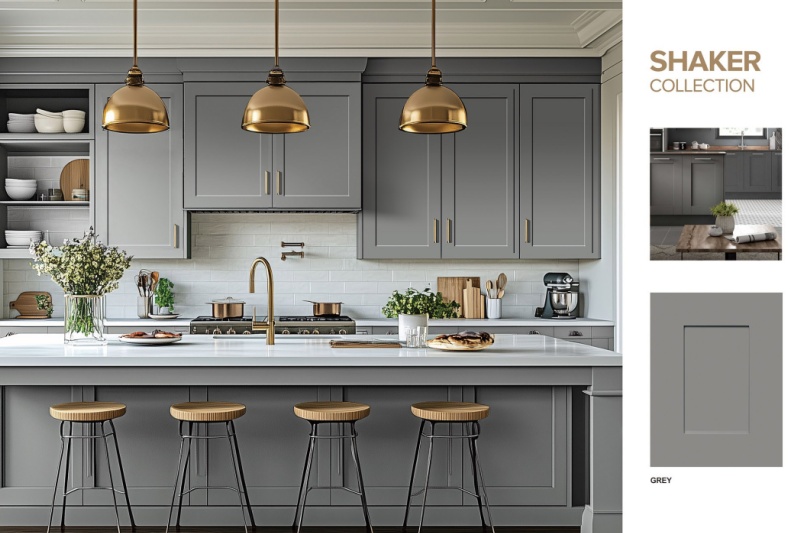
1. Material Composition & Structure (Core Difference)
Differences in material makeup and construction are the root of all performance gaps, and define the pros and cons of each for kitchen cabinetry. Plywood resembles a layered cake with distinct laminations, while particle board is more like a compressed biscuit made of fine wood particles.
Plywood is an engineered wood product manufactured by gluing thin solid wood veneers into stacked sheets, typically with an odd number of layers: 3-ply, 5-ply, 7-ply or more. Its defining feature is cross-lamination: adjacent veneer layers have grain directions perpendicular to one another. This cross-grain design counteracts the natural expansion and contraction stresses of solid timber, minimizing warping and cracking common in solid wood.
Particle board is produced by grinding wood into uniform flakes, chips and shavings, then bonding these particles with resin under high heat and pressure. It features a granular internal structure with no visible lamination. Premium modern particle board often adopts a three-layer configuration: larger core particles deliver stability, while fine surface particles create a smooth finish. Even so, compared with plywood’s continuous veneer layers, its wood fibers are fully fragmented, creating inherent structural limitations.
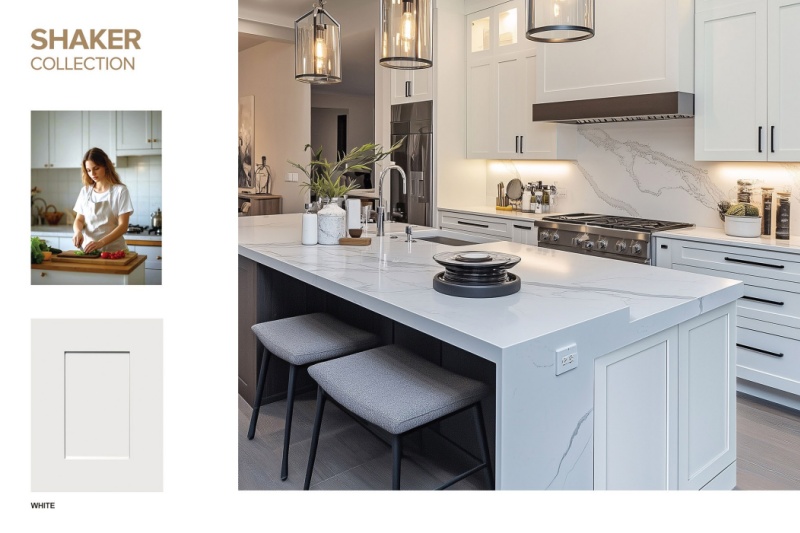
2. Performance Comparison for Kitchen Environments
Kitchens impose demanding operating conditions on cabinet materials: persistently elevated humidity, frequent water splashes, static load from countertops and built-in appliances, repeated abrasion from opening and closing doors, plus exposure to hot steam. High substrate performance standards are therefore required.
2.1 Moisture Resistance & Water Tolerance
- Plywood holds a clear advantage. Thanks to its continuous cross-laminated veneer structure, plywood has low water absorption and swelling rates. When exposed to accidental spills or short-term plumbing leaks in kitchens, it can mostly recover after drying without permanent deformation or structural failure. Even in consistently humid kitchen spaces, cabinet-grade plywood maintains stable dimensions and structure, resisting bubbling and delamination. For this reason, high-quality plywood American standard kitchen cabinets outperform particleboard alternatives in moisture resistance.
- Particle board fares poorly against moisture. The numerous gaps between internal wood particles readily absorb liquid water and water vapor. Once moisture penetrates the core, wood particles swell rapidly, causing irreversible board expansion, surface bubbling and edge banding failure. For flat frameless kitchen cabinets with particle board boxes, intact surface laminates are essential to prevent structural breakdown, since particle board cannot match plywood’s moisture resistance.
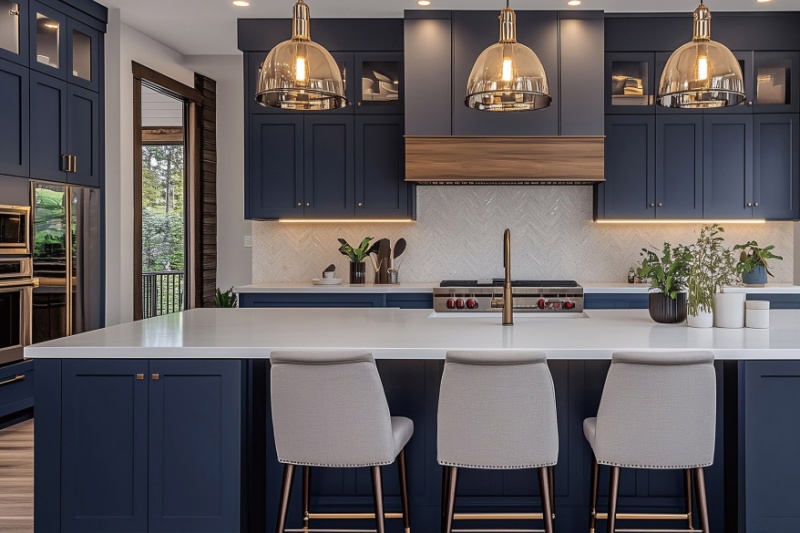
2.2 Structural Stability & Anti-Warping Capacity
- Kitchen cabinets must support constant static loads, including stone countertops and built-in ovens or refrigerators, without sagging or bowing. Plywood outperforms particle board in this regard. Its cross-grain construction balances internal stresses in all directions and distributes loads evenly, delivering strong bending resistance and deformation resistance. Well-made plywood cabinets can remain free of sagging for decades.
- Particle board features uniform density but lacks structural flexibility. Randomly stacked wood particles have limited directional stress resistance. Cabinets built from particle board are prone to bending and localized sagging under sustained heavy loads or uneven humidity conditions.
2.3 Screw-Holding Power
- Hinges, drawer slides and all cabinet hardware rely on the substrate’s screw-holding capacity, which determines long-term functionality of doors and drawers. Plywood’s continuous wood veneer structure allows screws to grip firmly within solid wood layers, delivering excellent pull-out resistance. Even after repeated disassembly and adjustment on full overlay Shaker plywood-framed kitchen cabinets, screw holes are less likely to strip or loosen, keeping hardware operating reliably long-term.
- Particle board’s loose particulate structure cannot form robust screw engagement; fasteners only anchor into discrete wood fragments. It has mediocre screw retention, especially along cut edges, and loosens easily after repeated assembly and disassembly. Once a screw hole fails in particle board, repair is difficult. This leads to loose hinges, drooping cabinet doors and sticky drawers — among the most frequent repair issues for budget kitchen cabinets.
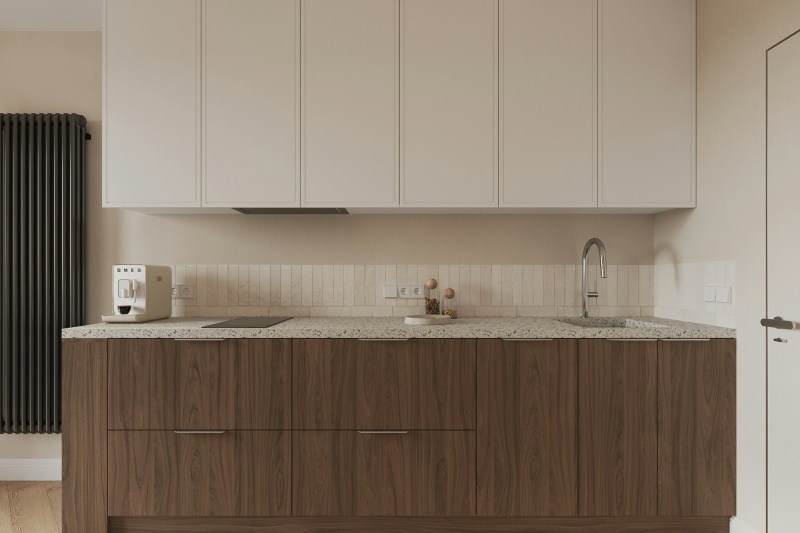
2.4 Strength & Load-Bearing Capacity
- Plywood is high-strength and flexible. It resists cracking and splitting under sudden impacts or concentrated pressure. Thickened plywood shelves support heavy weights without bending, making it ideal for base cabinets and appliance cutouts such as oven niches. Choose plywood cabinets if you require high-capacity kitchen storage.
- Particle board is hard yet brittle, with poor impact resistance. It chips easily along edges and develops hidden internal fractures under concentrated weight or knocks. Its maximum load rating is lower; prolonged weight from cookware and tableware accelerates shelf deformation and damage.
2.5 Environmental Performance
- Adhesive is only applied between veneer layers in plywood, resulting in comparatively lower resin consumption. Premium E0/E1 kitchen plywood releases minimal formaldehyde and meets international indoor air quality standards. All cabinet products supplied by our Union Woods factory in Vietnam are certified to the top E0 environmental grade.
- Particle board requires large volumes of adhesive to bind fragmented wood particles together, leading to higher total glue usage. While high-grade particle board may use low-emission adhesives, its overall environmental performance still lags behind qualified plywood. Under kitchen heat cycles, poor-quality particle board suffers adhesive degradation and ongoing formaldehyde offgassing.
3. Price Comparison
Low material cost explains particle board’s continued large market share. It efficiently consumes wood scraps and offcuts, maximizing lumber utilization and keeping production costs down. Plywood uses quality wood veneers and demands complex multi-layer pressing processes, with higher raw material and manufacturing expenses, positioning it as a mid-to-high-end cabinet substrate. Particle board is the more economical choice when upfront kitchen cabinet cost is the top priority.
4. Material Selection Guide by Application
No material is universally superior; suitability depends on the project context. Below are targeted recommendations based on kitchen zones and usage requirements:
Prioritize plywood if you:
- Value long-term home quality and expect cabinets to last 15+ years
- Have a humid kitchen with poor ventilation or high water exposure (near sinks and dishwashers)
- Need heavy-duty storage or built-in large appliances including ovens, steam ovens and refrigerators
- Want stable hardware with minimal cabinet maintenance
- Are building a custom luxury kitchen for long-term owner occupancy
Prioritize particle board if you:
- Need short-term rental renovations or budget cosmetic updates
- Have a dry, well-ventilated kitchen with rare water spills
- Are building wall cabinets with low load requirements (no heavy stored items)
- Manage low-budget multi-unit commercial projects and need to minimize upfront expenditure
5. Tips to Extend Cabinet Service Life
Whether selecting plywood or particle board cabinets, proper maintenance slows material aging.
- Particle board cabinet care: Maintain intact edge banding to block moisture ingress. Do not store wet dishware inside cabinets. Wipe water stains and grease from cabinet surfaces promptly, especially near sinks and cooktops. After cleaning with a damp cloth, follow immediately with a dry cloth to keep surfaces dry. Inspect and retighten loose hardware periodically.
- Plywood cabinet care: Wipe cabinet finishes regularly. Avoid prolonged direct contact with extreme heat and maintain kitchen airflow. Do not use strong acids, alkalis or steel wool, which can etch or scratch surfaces. Prevent prolonged direct sunlight, which causes fading and cracking; use curtains to block ultraviolet light.
Final Conclusion
For owner-occupied residential kitchen cabinets, plywood is the superior long-term option. Its excellent moisture resistance, structural stability, screw retention and service life align perfectly with the harsh operating conditions of kitchens, avoiding common particle board failures such as swelling, warping and loose hardware.
Particle board is only suitable for budget-limited, short-cycle applications or dry, low-load kitchen areas. Although it reduces initial renovation spending, its shorter lifespan and recurring maintenance create hidden costs and inferior user experience. Cabinet substrate defines the upper limit of cabinet quality. Investing in premium plywood is a cost-effective choice for kitchen remodeling or new construction.



 Newsletter
 Español
 IPv6 network supported