
What Are You Looking For?

On August 11, 2026, the General Department of Vietnam Customs issued Official Letter No.20173/CHQ‑NVTHQ, formally responding to an inquiry from the Vietnam Timber and Forest Products Association on export tax rates for logs and sawn timber. This seemingly routine administrative reply clarifies the enforcement logic of Vietnam’s wood‑export regulation and imposes stringent compliance obligations on FDI (Foreign‑Direct‑Invested) enterprises and EPE (Export‑Processing‑Enterprise) entities operating in Vietnam. Against the backdrop of intensive new fiscal‑tax and customs regulations rolled out in Vietnam from 2025 to 2026, this article sorts out corporate compliance challenges and practical implementation hurdles, and puts forward actionable countermeasures.
Article‑by‑Article Interpretation of the Official Letter: Underlying Regulatory Logic
1. Core of Classification: “Enterprise‑Burden‑of‑Proof” Principle for HS Codes
The Vietnam Timber Association sought clarification on unified wood‑export tax rates. Instead of giving a direct answer, the General Department of Vietnam Customs emphasized that incomplete information declared by enterprises prevents customs authorities from determining specific HS codes. Pursuant to Article 16 of Decree No.08/2015/NĐ‑CP, commodity classification shall be based on customs declarations, technical documentation, and information concerning composition, physicochemical properties, functions and end‑use. In short: where enterprises fail to submit complete supporting documents, authorities reserve the right to withhold classification and applicable tax‑rate confirmation. Valid HS‑code determination must be backed by full evidence.
2. Tax‑Rate Rules: Tax Burden Determined by Processing Depth
Though customs declined to assign specific HS codes, it published export tax rates for typical wood products, establishing a clear rule: lower tax rates for deep‑processed goods and higher rates for lightly‑processed goods. The maximum gap in tax burden can reach five‑fold, directly shaping corporate profit margins.
| HS Code Group | Product Description | Export Tax Rate |
| 44.03 | Logs (whether or not bark‑removed, sapwood‑stripped, or roughly squared) | 25% |
| 44.07 | Wood sawn or chipped length‑wise, over 6 mm thick (whether or not planed, sanded, or end‑jointed) | 25% |
| 44.08 | Veneer sheets ≤ 6 mm thick (whether or not planed, sanded, or jointed) | 10% |
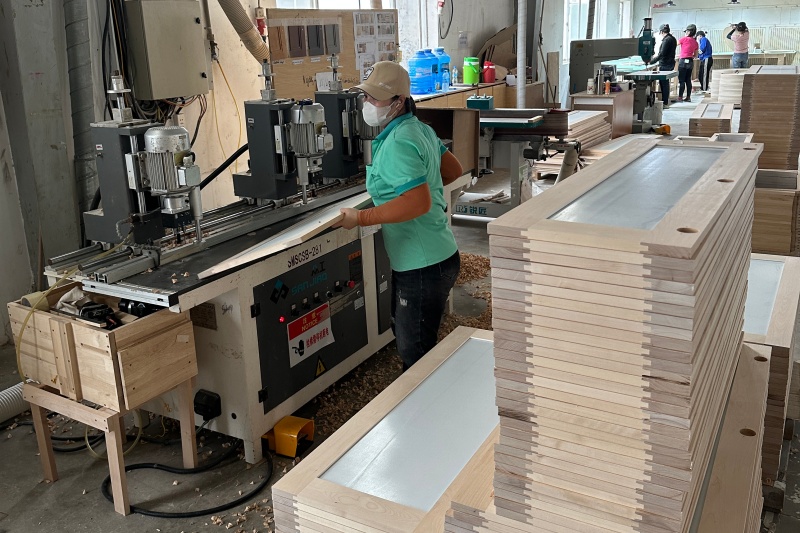
| 44.09 | Wood continuously shaped by grooving, tenoning, chamfering or similar operations | 5% |
3. Tax‑Exemption Red Line: EPE Enterprises Hold No Inherent Tax‑Exemption Privilege
Citing Clause 6, Article 16 of the Law on Import and Export Tax and Clause 2, Article 10 of Decree No.134/2016/NĐ‑CP (amended and supplemented by Decree No.18/2021/NĐ‑CP), the official letter stipulates: export goods manufactured by EPE export‑processing enterprises using domestically‑sourced Vietnamese wood shall not enjoy export‑tax exemption for the portion corresponding to domestic‑material value. Enterprises must strictly separate imported bonded raw materials from taxable domestic‑sourced materials and declare them separately. Where accurate separation cannot be achieved, customs may reject tax‑exemption applications.

Policy Background: Comprehensive Overhaul of Vietnam’s Fiscal‑Tax Regime (2025‑2026)
This official letter is not an ad‑hoc regulatory adjustment; it reflects the implementation of sweeping fiscal‑tax and customs reforms over the past two years. Legacy compliance practices may quickly become obsolete, requiring enterprises to rebuild their compliance frameworks. A summary of key new regulations is shown below:
| Regulatory Document | Core Provisions | Effective Date |
| Law on Value‑Added Tax No.48/2024/QH15 | Reforms VAT system; substantial impact on semi‑processed wood products | 1-Jul-25 |
| Decree No.182/2025/NĐ‑CP | Amends implementing regulations for the Import‑Export Tax Law to align with legislative overhaul | 1-Jul-25 |
| Decree No.167/2025/NĐ‑CP | Revises provisions governing customs procedures, inspection, supervision and control | 15-Aug-25 |
| Circular No.121/2025/TT‑BTC | Abolishes tax‑audit workflows for paper‑based / scanned customs declarations; full digital transformation | 1-Feb-26 |
| Decree No.108/2025/NĐ‑CP | Adjusts preferential import‑export tax‑rate schedules | 19-May-25 |
| Tax Administration Law No.108/2025/QH15 | Establishes an all‑new tax‑supervision framework | 1-Jul-26 |
Seven Common Corporate Risks (Critical for FDI / EPE Mitigation)
Under the new regulations and customs enforcement priorities, Vietnamese wood‑processing and export‑oriented enterprises face seven material risks:
Four Core Practical Compliance Bottlenecks
Vietnam‑based wood enterprises encounter major real‑world obstacles in compliance execution, centering on four pain points:

Actionable Compliance Strategies
Given the current regulatory landscape, enterprises should shift from reactive remediation to proactive compliance by implementing seven key measures:

Conclusion: Compliance as a Core Competitive Edge for Enterprises in Vietnam
This customs official letter signals tighter, evidence‑driven and granular regulation across Vietnam’s wood sector. Amid the comprehensive policy overhaul of 2025‑2026, extensive‑mode operation and experience‑reliant compliance are no longer viable.
For FDI and EPE wood enterprises, minor deviations in tax‑rate application, HS‑code assignment or material accounting can trigger substantial financial losses. Proactive enhancement of compliance frameworks and alignment with regulatory rules represent not merely operating expenses, but essential foundations for sustaining operations in Vietnam, mitigating risks and sharpening market competitiveness.


 Newsletter
 Español








 IPv6 network supported