
What Are You Looking For?
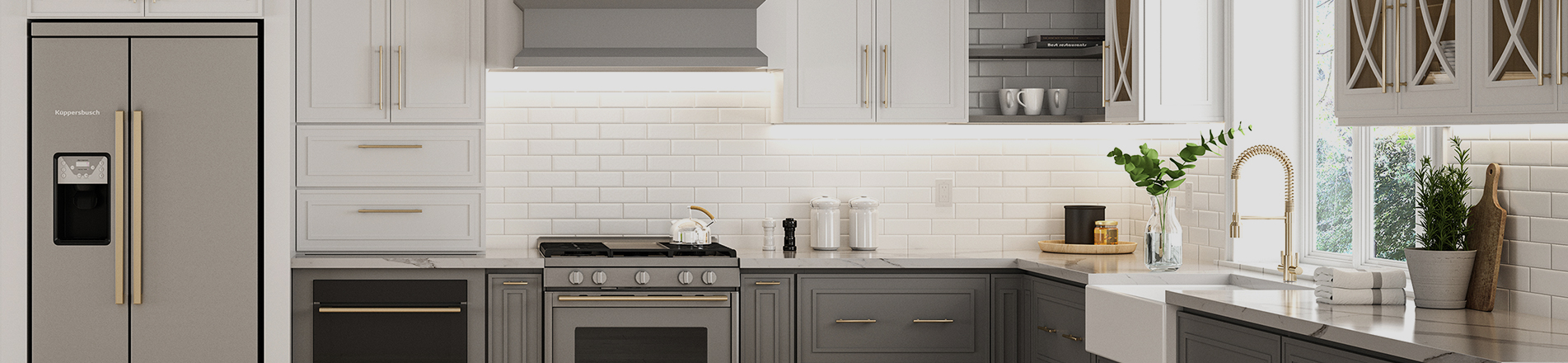
Among all cabinet styles, popular options include slim shaker and regular shaker. Both feature clean, timeless lines, which is why shaker cabinets remain a classic choice. When choosing between the two, some people prioritize price, leading to the question: Is slim shaker more expensive than regular shaker cabinets?
In short: It depends, but when using the same materials, regular shaker cabinets are slightly more expensive than slim shaker cabinets, though the price difference is not significant. The price gap is determined by multiple factors including design details, materials, craftsmanship, and order quantity. We break down each factor below to explain why regular shaker cabinets cost more.

Definitions of Slim Shaker vs. Regular Shaker Styles
Before comparing prices, let’s clarify the difference between slim shaker and regular shaker cabinets. Both follow the core shaker design philosophy: function-first simplicity and purity. The only difference lies in the frame proportion—and this difference directly affects pricing.
Regular (Classic) Shaker Cabinets
Regular shaker is the original classic shaker design; all other shaker variations are refined from this base to suit different kitchen styles.A shaker cabinet door consists of four frame stiles/rails and a center panel, with the frame typically 2.5–3 inches wide.The wider frame ensures structural sturdiness and delivers a solid, stable visual effect, ideal for farmhouse and traditional kitchens. The center panel is usually recessed deeply, adding layers and a classic, substantial texture.Widely used and readily available, regular shaker has long been a staple in home design.
Slim Shaker Cabinets
Slim shaker is a modern interpretation of classic shaker cabinets.Its frame is significantly narrower, usually 0.5–1 inch, with a shallow recessed center panel. This reduces the heavy look, creating a cleaner, sleeker profile that matches modern aesthetics for a light, contemporary feel.It works especially well for modern, minimalist, or small-space kitchens, as the slim lines make the kitchen feel more open and less cramped.

Why Are Regular Shaker Cabinets Usually More Expensive?
Now we address the key question: Why do regular shaker cabinets cost more than slim shaker? Below are the most critical factors:
1. Precision Craftsmanship = Higher Labor Costs
Regular shaker cabinets involve more complex construction.They are assembled from four frame pieces plus a center panel, requiring precise cutting with professional tools—small errors can ruin the entire door. Skilled labor and extra assembly time raise labor costs, which are reflected in the final price.By contrast, slim shaker uses a single main panel with thin trim strips, so labor costs are lower.
2. Material Usage
Slim shaker’s narrow frame uses less solid wood, lowering material costs.Regular shaker’s wider solid-wood frame consumes more material. However, the overall material difference is modest, so the price gap remains small.
3. Surface Finishing
Regular shaker doors have more components, each requiring high-quality finishing—extra sanding, consistent painting, and no color discrepancies. These extra steps add to production costs.

Key Conclusion
With identical materials and quality from the same kitchen cabinet wholesaler, regular shaker cabinets are slightly more expensive than slim shaker cabinets. The price difference is more noticeable for high-end oak cabinets.
For specific quotations, you can consult Union Wood. As a professional cabinet supplier, we offer competitive wholesale pricing, with a full range of styles and colors to meet all wholesale and project requirements.
If budget is not a concern, how to choose between Slim Shaker and Regular Shaker?
In fact, choosing the most suitable cabinet style depends on several key factors. As a cabinet supplier, Union Wood has a professional design team that provides tailored advice based on the owner’s needs.

Home Architectural Style
Space Size
Personal Style Preference
In addition, both Regular Shaker and Slim Shaker are compatible with a variety of countertop materials, including marble, quartz, and solid wood. With different hardware options, they can match many styles for a personalized look.
We support one-stop procurement, providing countertops, sinks, hardware, and other matching products for a hassle-free experience.

Material Selection for Slim Shaker & Regular Shaker Cabinets
In addition to design style, the price of cabinets is largely determined by the materials used. We offer a variety of materials including Solid Wood, Plywood, MDF, and Particle Board. Each material has its own advantages and disadvantages, allowing you to choose based on your actual needs.
| Comparison Items | Solid Wood | Plywood (Multi-layer Board) | MDF (Medium Density Fiberboard) | Particle Board |
| Core Material | Natural solid wood, retaining natural wood grain and structure | Made by gluing and pressing multiple layers of thin wood veneers | Made from wood fibers with adhesive, pressed under high temperature and pressure | Made from wood particles with adhesive, pressed under high temperature and pressure |
| Appearance & Texture | Natural and unique grain, with natural knots and grain patterns, delicate texture, high recognition | Surface with veneer grain, close to natural solid wood | Smooth and flat surface; requires veneer or painting for grain | Rough texture, poor feel; needs veneer to improve appearance |
| Environmental Performance | No adhesive (solid wood), best environmental performance | Uses adhesive for bonding veneers; meets E0 standard | Evenly dispersed fibers with large amount of adhesive; high-quality E0 grade suitable for household use | Large gaps between particles needing more adhesive; high-quality products can reach E0 standard |
| Physical Properties | High strength, good toughness, but susceptible to temperature/humidity, easy to deform/crack (needs moisture-proof treatment) | Stable structure, not easy to deform/crack, medium strength, better moisture resistance than MDF & particle board, good load-bearing capacity | Smooth surface, uniform density, good compression resistance, but poor moisture resistance, easy to expand/deform when wet | Low density, poor strength, bad moisture resistance, easy to expand/loosen when wet |
| Processability | Sawable, planable, millable, carvable; medium processing difficulty, high craftsmanship requirement | Easy to process (saw, plane, drill); suitable for complex shapes | Excellent processability, smooth surface, easy to sand/paint, ideal for fine carving & complex shapes | Simple processing but rough surface, easy to chip; not for fine processing, mostly for basic cabinets & non-exposed parts |
| Moisture Resistance | Average moisture resistance; needs painting/waxing, otherwise absorbs moisture and deforms | Good moisture resistance; multi-layer structure reduces moisture absorption, suitable for humid areas (kitchen, bathroom) | Poor moisture resistance; easy to expand/soften when absorbing water, not for humid environments | Worst moisture resistance; expands/looses quickly when wet, only for dry environments |
| Price Range (Same Thickness) | Highest; scarce natural wood, price varies greatly by wood type (oak, cherry, etc.) | Medium; better than MDF & particle board, price slightly fluctuates with veneer material & layers | Moderate cost-performance; lower than solid wood & plywood, higher than ordinary particle board | Lowest; easy-to-get raw materials & simple processing, most cost-effective basic board |
| Common Uses | High-end furniture | Furniture cabinets, cabinet doors | Furniture cabinets, cabinet doors | Ordinary furniture cabinets, drawer bottoms, non-load-bearing parts |
For both wholesale and project orders:

As a Vietnam-based kitchen cabinet supplier, Union Wood not only customizes cabinet materials but also provides customization for colors and surface finishes.We also design cabinet dimensions and select hardware accessories based on your floor plans, delivering efficient kitchen solutions.


 Newsletter
 Español
 IPv6 network supported